The Wave at Seventy: How Hokusai Started Over with Thirty-six Views of Mount Fuji
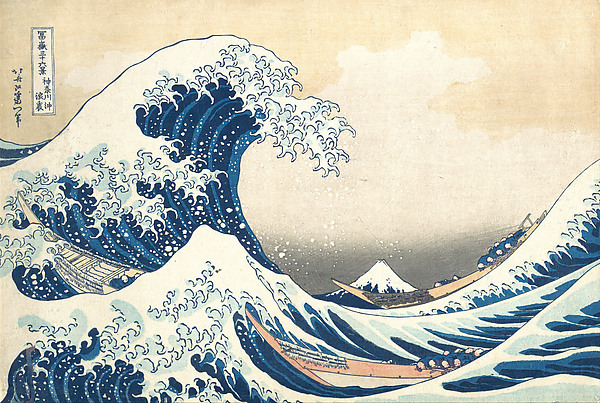
Picture the most famous image in Japanese art. You are almost certainly seeing a wave — that wave, with its claw-like crest of foam frozen in the instant before it crashes down on three narrow boats. Now consider the circumstances of the man who designed it. Katsushika Hokusai was around seventy years old. He had recently weathered a stroke, the death of his second wife, and a grandson whose gambling debts had drained the old man’s savings so thoroughly that, by some accounts, he was reduced to peddling pictures door to door.
The print series he began in these years, Thirty-six Views of Mount Fuji, was not a victory lap. It was a comeback attempt by an artist who had every reason to be finished — and it worked.
An artist who kept changing his name
Hokusai was born in Edo (present-day Tokyo) in 1760 and spent his life inside the commercial print world of the city. Ukiyo-e — “pictures of the floating world” — was popular entertainment, not fine art: publishers commissioned designs, block carvers and printers executed them, and the sheets sold for roughly the price of a bowl of noodles.
Over a career of some seventy years, Hokusai used more than thirty different art names, shedding each one as his style shifted. He drew actors, courtesans, landscapes, ghosts, and the sketchbook collections known as Hokusai manga, which became bestsellers in their own right. By the 1820s he was signing himself with a name that tells you how he saw his own situation: Gakyō rōjin, “the old man mad about painting.”
The debts, the stroke, and the mountain
The late 1820s hit him in quick succession. His wife died. He suffered a stroke, and treated himself, according to tradition, with a folk remedy of citron and sake. Above all there was the grandson, whose debts Hokusai and his daughter Ōi repeatedly covered until the household was stripped bare. Surviving letters from these years show the artist asking publishers for advances and describing his poverty in plain, unembarrassed terms.
So when the publisher Nishimuraya Yohachi announced a new series of landscape prints around 1830, the project carried real financial weight. The premise was simple and commercially shrewd: the same mountain, seen from thirty-six different places. Fuji was an object of popular devotion — pilgrimage confraternities climbed it every summer — and a landscape series let a print buyer collect view after view, the way one might collect stamps.
A new blue changes everything
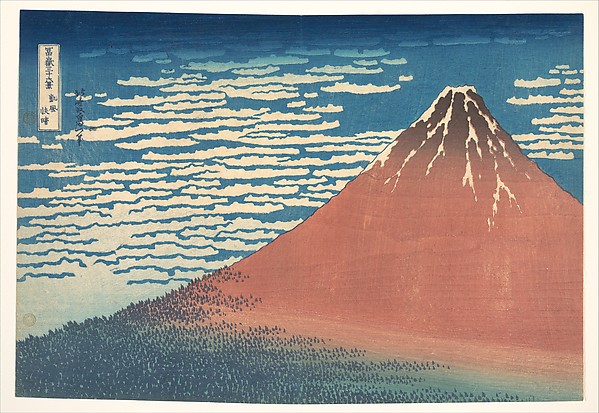
One material fact made the series look like nothing before it: Prussian blue. This synthetic pigment, imported through Dutch and Chinese trade, had recently become cheap enough for commercial printmaking. Unlike the vegetable blues of earlier ukiyo-e, it did not fade to grey within a few years, and it could be graded from near-black depths to pale sky.
Hokusai and his publisher leaned into the novelty. Early advertisements for the series promoted its use of berorin ai — “Berlin blue” — as a selling point, and several designs were first issued printed almost entirely in shades of it. The sea in the Great Wave, the sky behind the red flank of Fuji in South Wind, Clear Sky: both depend on that one imported color.

South Wind, Clear Sky and Storm below Mount Fuji form a pair of experiments in how little a landscape needs. No figures, no anecdote — just the mountain at dawn, and the mountain with lightning cracking beneath it. For an audience used to landscapes as backdrops for travelers and teahouses, this was a strange, confident reduction.
People at work, mountain at rest
Most of the series, though, is full of people — and almost none of them are looking at Fuji. That is the quiet joke running through the whole project. Coopers bend inside a giant barrel, sawyers straddle beams, travelers chase their hats in a gust of wind, and the mountain sits in a gap of the composition, unnoticed by everyone except us.
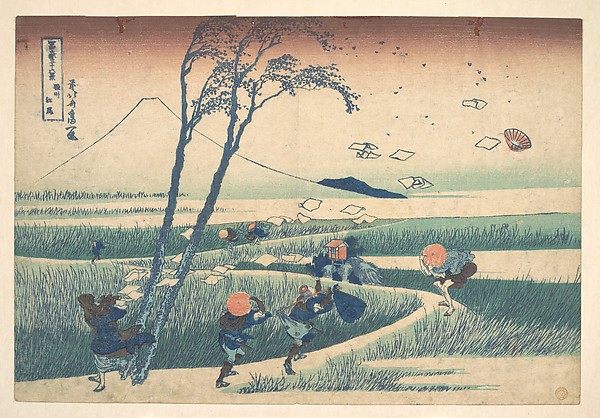
In Ejiri in Suruga Province, a gust strips papers from a woman’s kimono and sends them spiraling into the sky; the travelers double over, and Fuji — drawn in a single pale outline — ignores the whole commotion. In Kajikazawa in Kai Province, a lone fisherman leans against the pull of his lines on a rocky spur, and the triangle of his braced body echoes the triangle of the mountain behind the mist.
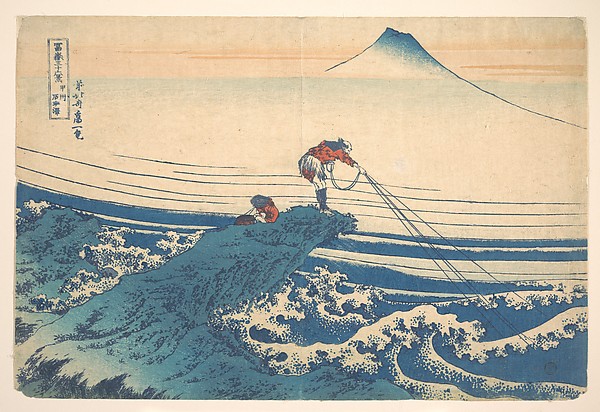
That structure — human effort in the foreground, the unmoved mountain behind — is the engine of the series. Hokusai had spent decades drawing every trade and gesture in Edo, and here that archive of observation gets a fixed point to push against.
Reading the Wave itself
Go back to the first print with all this in mind and it reorganizes itself in front of you.
The boats are oshiokuri-bune, fast vessels ferrying fresh fish to the Edo markets; the men are rowing for a living, not sightseeing. The wave’s foam breaks into fingers that seem about to grasp them. And Fuji, far off in the trough, is drawn so small that first-time viewers sometimes mistake it for another wave. The composition holds three time scales in one frame: the wave’s next second, the rowers’ next hour, the mountain’s next ten thousand years. Nothing in the image tells you which scale matters most — which is much of why people have kept arguing about it for nearly two centuries.
Commercially, the gamble paid off. The series sold well enough that the publisher extended it beyond thirty-six designs to forty-six, and it opened a decade in which landscape became a leading genre of ukiyo-e — the lane in which Utagawa Hiroshige would soon build his own career.
Five more years
Hokusai kept working through his eighties, signing late paintings with age-statements — “from the brush of the old man mad about painting, aged eighty-eight” — as if his years were part of the medium. A famous account of his death in 1849 has him wishing aloud for just five more years, so that he could become a true painter.
Whether or not the deathbed scene happened exactly that way, the sentiment matches everything the documents show: a septuagenarian who answered debt, illness, and grief with a series about one unmovable mountain and the busy, precarious people living around it. He did not paint his troubles. He painted everyone’s.
Katsushika Hokusai, Under the Wave off Kanagawa, ca. 1830–32, The Metropolitan Museum of Art
🔍 Zoom into the brushwork — scroll or pinch to explore
All images are public domain, linked to the holding museum.